

Should You Buy the Vision Pro?
The Apple Vision Pro, priced at $3,500, remains a significant investment for most consumers. Reviews have highlighted that while it is a technological marvel, it does not seamlessly fit into everyday workflows for the majority of users. Some early adopters have expressed regret due to the headset's limited app ecosystem and high price point. However, the Vision Pro excels in specific use cases such as watching movies, viewing 3D videos, and serving as a high-resolution display for a Mac.
Comfort has been a concern with the original model, but the M5 version introduced in October 2025 includes a Dual Knit Band that improves weight distribution and reduces fatigue. The headset weighs over 1.3 pounds and still requires an external battery pack, which can be cumbersome for travel. Apple advises potential buyers to try the device at an Apple Store and thoroughly research its capabilities before purchasing.
The M5 upgrade makes now a good time to buy, as Apple has paused development on a next-generation model for at least two years.
Apple Vision Pro Overview
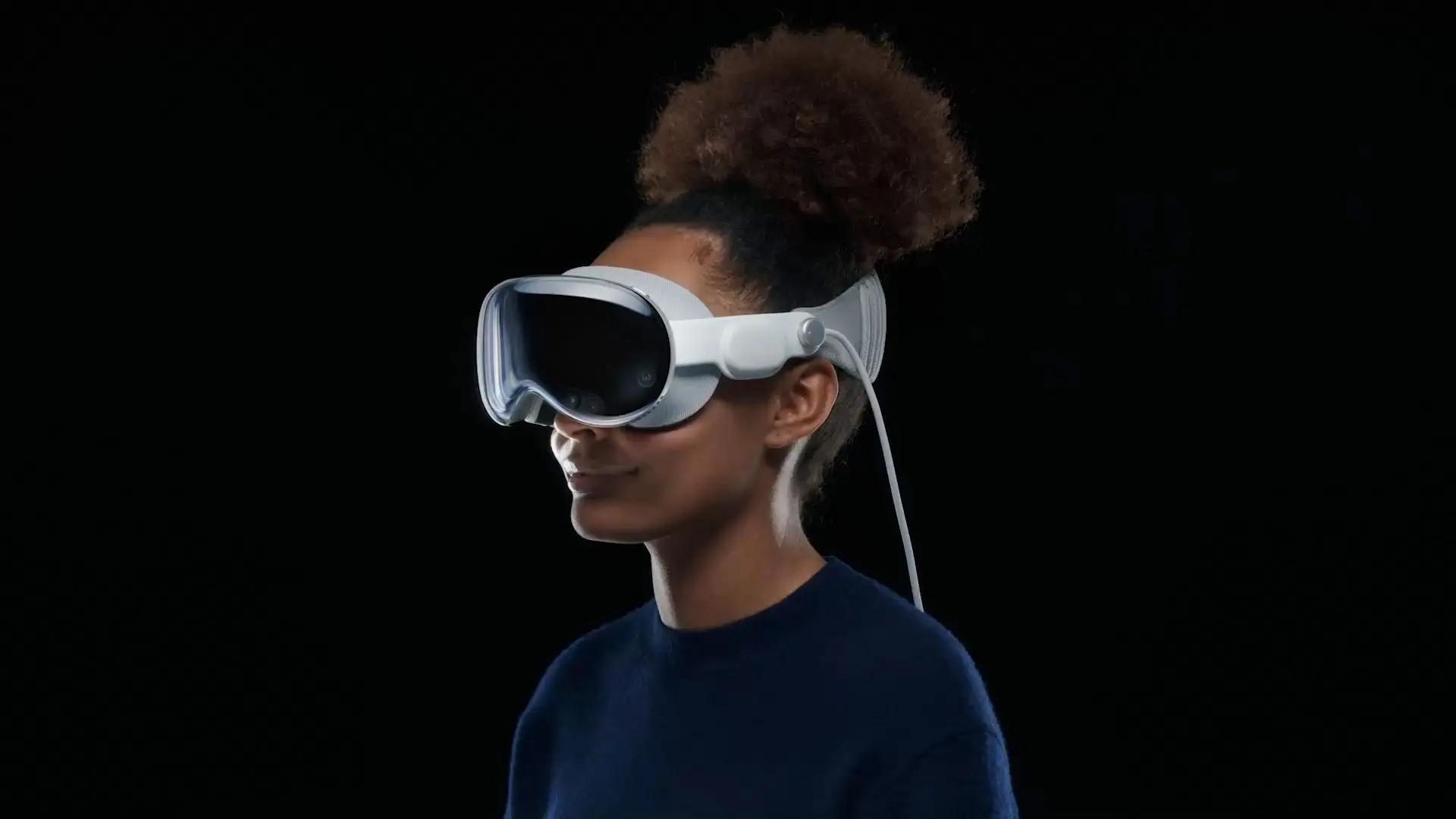
Apple Vision Pro is a mixed reality headset that Apple markets as a "spatial computer." It blends augmented and virtual reality using high-resolution cameras and sensors. The device features two micro-OLED displays with over 23 million pixels, providing sharp visuals. A unique external display called EyeSight shows the wearer's eyes to others, indicating when the user is immersed in VR.
Navigation is entirely gesture-based: users control the interface with eye tracking, hand gestures, and voice commands. There are no physical controllers. The headset is powered by the M5 chip and a dedicated R1 processor that handles real-time sensor data. The M5 chip offers a 10-core CPU and 10-core GPU, delivering up to 50% faster AI performance compared to the M2.
Design and Display
The Vision Pro resembles ski goggles with a laminated glass front and aluminum alloy frame. A Light Seal attaches magnetically to block light, and the new Dual Knit Band uses two straps for better support. The headset is available only in silver with gray accessories. The display inside each eye delivers over 4K resolution, and the M5 model supports up to 120Hz refresh rates for smoother motion.
Zeiss optical inserts are available for prescription glasses users at an additional cost of $149 for custom lenses or $99 for readers. The headset's external EyeSight display projects the user's eyes, helping others know whether the wearer can see them.
Cameras, Sensors, and Navigation
Apple Vision Pro includes 12 cameras and five sensors. Two cameras transmit over a billion pixels per second for AR passthrough, while infrared cameras track eye movements for precise navigation. LiDAR sensors map the environment. Hand gestures are detected even when hands are resting. Optic ID uses iris scanning for secure authentication, similar to Face ID.
The headset can capture 3D photos and videos using a dedicated camera button. When recording, the external display shows an animation to alert others. This feature allows users to relive memories in immersive 3D.
Audio and Connectivity
Speakers built into the head straps deliver spatial audio with dual drivers. The device supports lossless audio with AirPods Pro 2 (USB-C) and AirPods Pro 3. Connectivity includes Wi-Fi 6, Bluetooth 5.3, and a USB-C battery pack. The Vision Pro does not support Wi-Fi 6E.
Processors and Performance
The M5 chip, built on 3-nanometer technology, provides a significant performance boost. It has a 10-core CPU and 10-core GPU with third-generation ray tracing. The unified memory bandwidth is 153GB/s, enabling on-device AI tasks. The R1 chip processes camera and sensor data in under 12 milliseconds for virtually lag-free passthrough.
The Vision Pro comes with 16GB RAM and storage options of 256GB, 512GB, or 1TB. The M5 model renders 10% more pixels and supports 120Hz refresh rates, improving clarity and reducing motion blur.
Battery Life and Power
The external battery pack provides up to 3 hours of video playback or 2.5 hours of general use, which is 30 minutes longer than the M2 version. The battery can be swapped for extended use, and the headset can be plugged into a wall adapter for unlimited operation.
visionOS Software
visionOS is the operating system designed for spatial computing. It features a 3D interface with apps that can be placed anywhere in the user's environment. Users can adjust immersion levels via the Digital Crown. The system supports multitasking with multiple windows and a virtual keyboard. visionOS integrates with Mac to provide a portable 4K display.
visionOS 26, released in September 2025, introduces persistent widgets, more lifelike Personas, and shared experiences with other Vision Pro users. A Travel Mode allows usage on planes, trains, and cars. Upcoming visionOS 27 will add face gestures for navigation, Vehicle Motion Cues to reduce motion sickness, and improved hearing aid support.
How to Buy
The M5 Vision Pro is available from Apple's online store and retail locations in several countries including the US, UK, Canada, Australia, China, and Japan. Pricing starts at $3,500 for 256GB. The ordering process requires a Face ID scan for proper Light Seal fitting. Zeiss lens inserts require a valid prescription. Apple does not offer trade-ins for the older M2 Vision Pro.
What's in the box: Dual Knit Band, Light Seal, two Light Seal Cushions, cover, polishing cloth, battery, USB-C charging cable, and power adapter.
Reviews and Impressions
Reviewers have praised the Dual Knit Band for improving comfort during extended use. The M5 chip provides more consistent performance with less lag and stuttering. The 10% pixel increase and 120Hz refresh rate result in crisper visuals, though the difference is not dramatic. The Vision Pro remains best suited for media consumption and Mac display use rather than productivity tasks.
Medical Warnings
Apple warns that the Vision Pro may exacerbate certain medical conditions, including heart conditions, migraines, dizziness, eye conditions, and psychological conditions. Pregnant individuals should use caution due to increased risk of nausea. The headset may interfere with pacemakers and other electronic implants.
What's Next for Vision Pro
Apple is reportedly pausing work on a next-generation Vision Pro to focus on smart glasses without a display, similar to Meta Ray-Bans. These smart glasses are expected to launch in late 2026 or 2027. A cheaper headset is also in development but not expected for at least two years.
Long-term plans include AR glasses that connect to Mac, but work has been halted. Apple is also exploring health applications, such as using eye tracking to detect depression or heart failure. Augmented reality contact lenses are a distant possibility for the 2030s.
Source: MacRumors News