

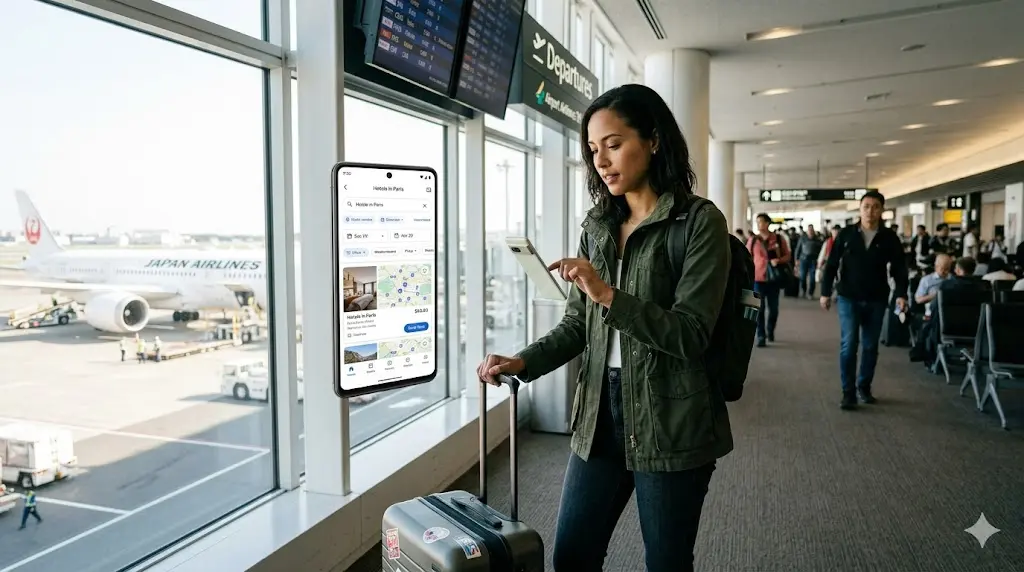
Mobile commerce has quietly reshaped how people travel across borders, from booking flights on the train ride home to paying for street food in a foreign country with a single tap. If you’re studying research on mobile commerce and its impact on international travel, here’s the core idea: mobile-first transactions are no longer a convenience, they’re the backbone of modern travel behavior. Travelers rely on mobile apps not just to book trips but to navigate, translate, pay, and even decide where to go next.
What most people miss is how deeply this shift changes traveler expectations. It’s not just about speed anymore. It’s about control, confidence, and instant access to decisions that used to require planning days in advance.
Mobile commerce is transforming international travel by making bookings, payments, navigation, and real-time decisions seamless. Travelers now depend on smartphones for almost every stage of their journey. This shift improves convenience but also raises expectations for instant service, digital payment compatibility, and personalized travel experiences.
What Is Mobile Commerce and Its Impact on International Travel?
Mobile Commerce (m-commerce): The use of smartphones and mobile devices to conduct financial transactions, bookings, and service interactions.
Mobile commerce in travel refers to everything a traveler does through a phone—buying tickets, reserving hotels, paying for transport, or accessing digital boarding passes. But its impact goes deeper than transactions.
In my experience, travelers don’t think of “mobile commerce” while traveling. They just expect things to work instantly. If a payment fails or a booking app lags, the frustration is immediate and disproportionate. That expectation is what makes this shift so powerful.
International travel is especially affected because it removes traditional barriers like currency exchange, language issues, and location uncertainty. A traveler landing in a new country can now function almost like a local within minutes.
Why Mobile Commerce Matters in 2026 for Global Travel
By 2026, international travel is becoming increasingly frictionless, and mobile commerce sits right at the center of that change. The biggest shift isn’t just technology—it’s behavior.
Here’s the thing: travelers now make decisions in real time instead of planning everything in advance. Someone might land in Bangkok without a hotel booked and choose one based entirely on mobile reviews and instant payment options.
A key driver of this is trust in digital ecosystems. Mobile wallets, QR-based payments, and integrated travel apps have reduced the need for cash or physical tickets. Even borderless payment systems are becoming more reliable, which is huge for cross-country travel confidence.
What most people overlook is how mobile commerce is also reshaping spontaneity. Travelers are more willing to change plans mid-journey because everything is accessible instantly.
How to Use Mobile Commerce While Traveling Internationally — Step by Step
Set up mobile payment systems before departure
Most travelers skip this step and regret it later. You need at least one globally accepted payment method linked to your phone.Download travel and navigation apps with offline support
Internet access isn’t always reliable abroad, so offline functionality becomes a safety net.Enable real-time currency conversion tools
This helps avoid overspending and confusion in unfamiliar pricing systems.Use mobile-based identity and ticket storage
Boarding passes, hotel confirmations, and even museum tickets are increasingly digital-first.Activate roaming or local eSIM options
Without connectivity, mobile commerce becomes useless. This step is often underestimated.
Common Mistake or Misconception
Many travelers assume mobile commerce is only about payments. That’s not true. In reality, it’s a full decision-making ecosystem. I’ve seen people struggle abroad not because they lacked money, but because they lacked digital readiness. That’s a very different problem.
Expert Tips: What Actually Works in Real Travel Scenarios
Let me be direct—mobile commerce works best when you don’t rely on a single app or system. I’ve personally found that travelers who diversify their digital tools (payments, navigation, bookings) rarely get stuck.
One counterintuitive point: too much automation can actually reduce travel satisfaction. When every decision is optimized by an app, some travelers feel less connected to the experience itself. At least from what I’ve seen, the happiest travelers still leave room for manual discovery.
Another insight: local payment adoption matters more than global apps in some regions. Even if your system works internationally, small local vendors might still prefer regional digital wallets.
Real-World Examples of Mobile Commerce in International Travel
A friend of mine traveled across Europe with no physical cash at all. Every purchase—from train tickets in Germany to coffee in Italy—was handled through mobile payments. The surprising part? The only issue they faced wasn’t payment failure, but occasional confusion with small vendors who didn’t expect fully digital tourists.
Another case involves a solo traveler in Southeast Asia who relied entirely on mobile booking platforms. They changed accommodations three times in one week based on reviews and location updates. Without mobile commerce, that level of flexibility would’ve been nearly impossible.
These examples show something important: mobile commerce doesn’t just support travel—it actively reshapes travel behavior.
Digital Travel Ecosystem: A connected system of mobile apps, payment tools, and travel platforms that allow travelers to manage every stage of international travel through a smartphone.
Expert Insights: What Most Research Misses
Here’s what most guides miss: mobile commerce isn’t just improving travel—it’s subtly changing how people choose destinations. Travelers are increasingly influenced by how “digitally friendly” a destination is.
If a country has poor mobile payment support or weak connectivity, it quietly drops down the list of preferred destinations. That’s not widely discussed, but it’s becoming a real factor in travel decision-making.
Another overlooked angle is emotional dependency. Travelers now feel anxious without mobile access, which changes how they experience independence abroad.
People Most Asked About Mobile Commerce and International Travel
How does mobile commerce improve international travel?
It simplifies payments, bookings, and navigation by allowing travelers to manage everything from a smartphone. This reduces dependency on physical currency and paperwork.
Is mobile commerce safe for international transactions?
In most cases, yes. Security has improved significantly, but travelers still need to use secure networks and trusted apps to avoid risks.
What is the biggest benefit of mobile commerce in travel?
Flexibility. Travelers can change bookings, routes, and plans instantly without waiting for physical confirmations.
Does mobile commerce work without internet access?
Partially. Some apps offer offline features, but full functionality requires connectivity for real-time updates and payments.
Why is mobile commerce important for tourism growth?
It increases traveler confidence, reduces friction in bookings, and supports spontaneous travel decisions, which boosts overall tourism activity.
Can mobile commerce replace traditional travel agencies?
Not entirely. While it reduces dependency, many travelers still prefer human support for complex or high-value trips.
For businesses aiming to grow visibility in the travel and digital commerce space, our Network site provides tailored solutions for Guest Posting Services and Press Release News Submission, helping brands achieve stronger brand visibility and organic traffic through high authority backlinks. Explore trusted distribution through press release distribution services and expand reach using digital marketing services to strengthen SEO ranking and gain media coverage. These platforms support instant publishing for agencies, startups, and enterprises looking to enhance online authority and performance-driven growth.